What it is
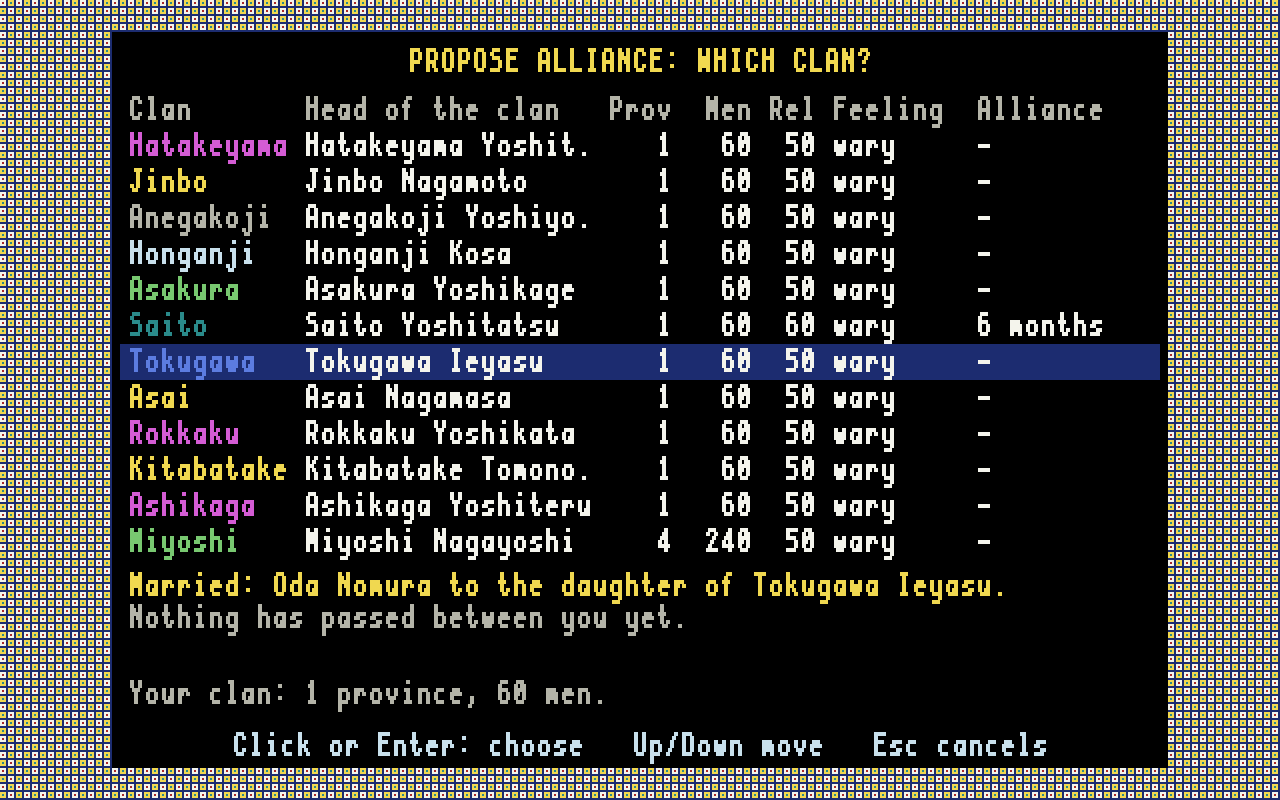
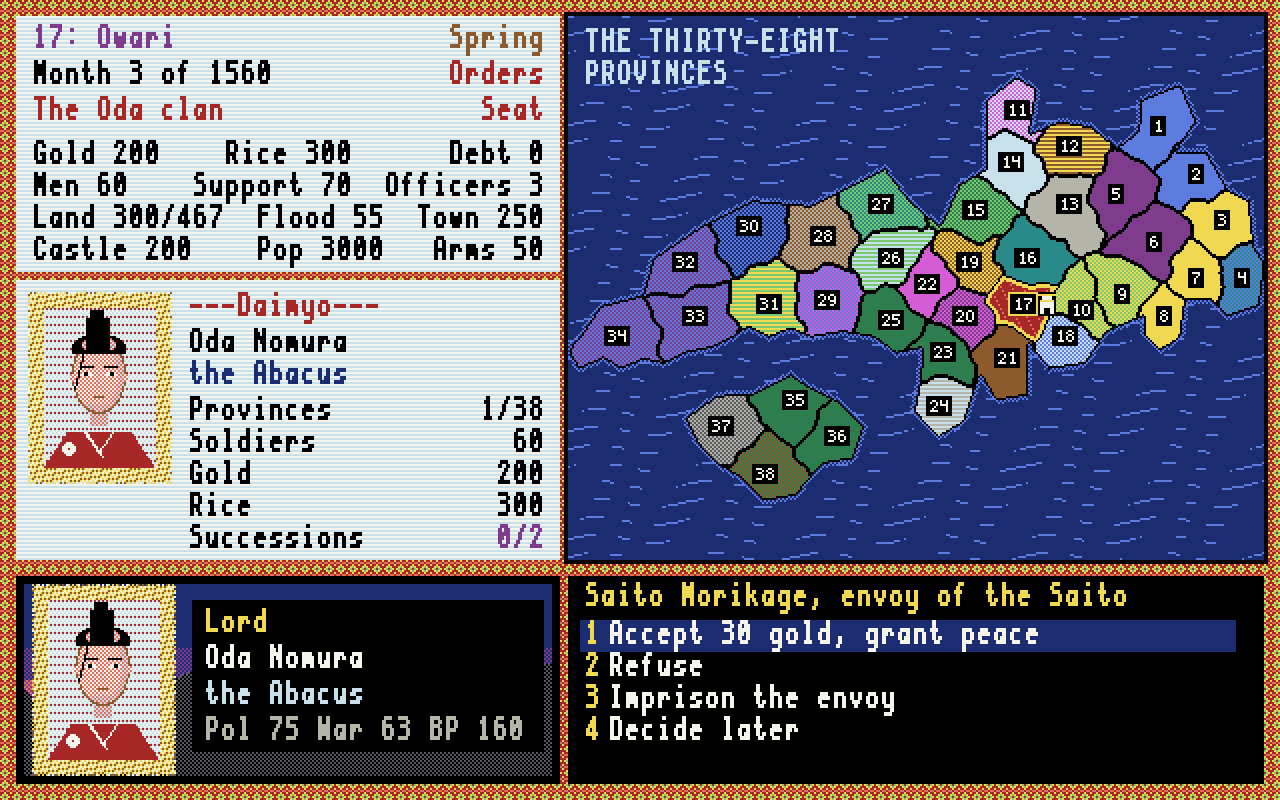
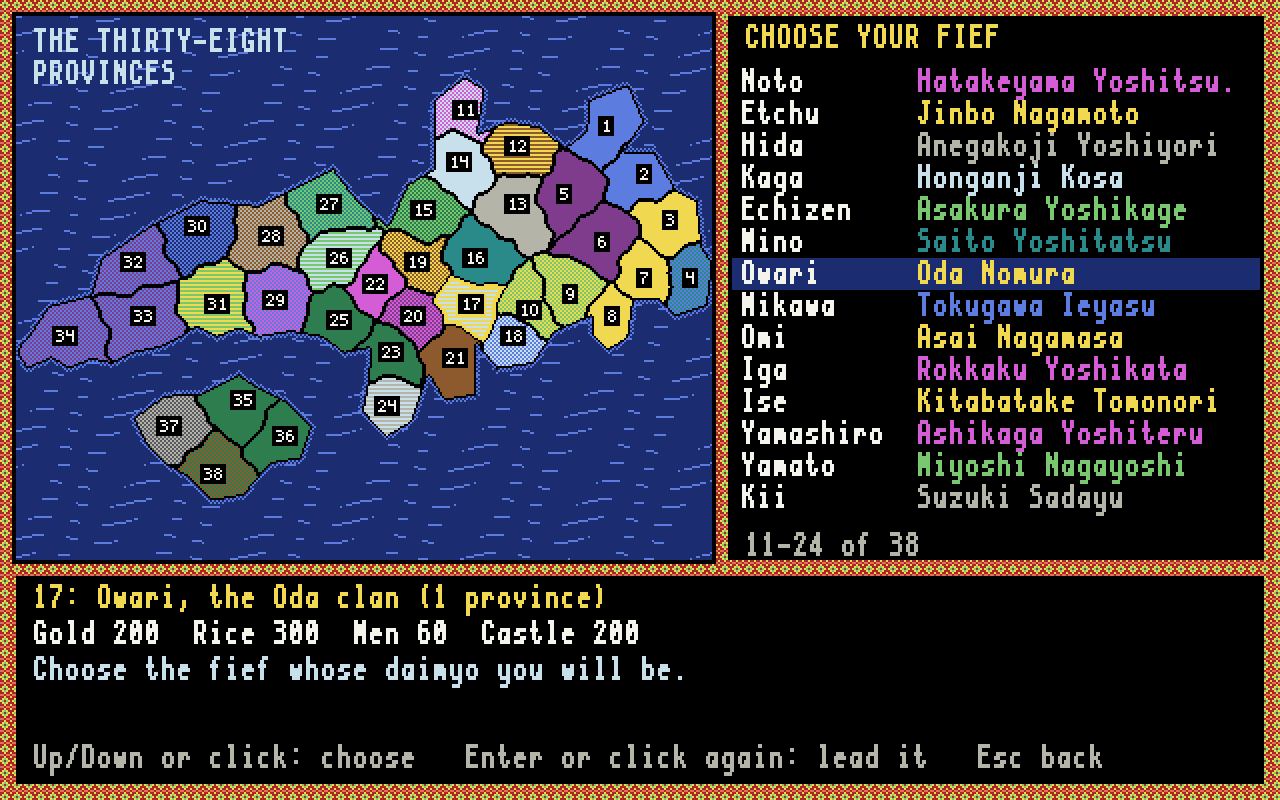
Sengoku is a turn-based strategy game written here at Kalgoorlie Retro Gaming. Choose the fief whose daimyo you will be, in the 1560 or 1582 scenario, and set your lord's politics, war, charisma and ambition. Each province has a governor and up to seven samurai, each with his own abilities, body points and men; you appoint one for every order. They cultivate land, build flood banks, develop towns, reinforce castles, hire, reassign and train soldiers, trade rice and arms, borrow from the moneylenders and move between your provinces with gold and rice. You search for ronin and lure your rivals' samurai, train and reward your officers, appoint governors and delegate provinces to them, and from your lord's seat arrange marriages that tie the clans together, propose alliances, threaten your neighbours, send tribute and answer the envoys who come to you; relations between the clans rise and fall. A governor left to rule alone may serve you well, or, if he is disloyal and ambitious, rebel and take his province to a rival. Rice and arms are traded at a market price that changes every month. Agents spread rumours that set rival clans against each other, stir up uprisings or assassinate a governor. Spring brings in the trade gold and autumn the rice harvest, while floods, typhoons and unhappy provinces can undo your work.
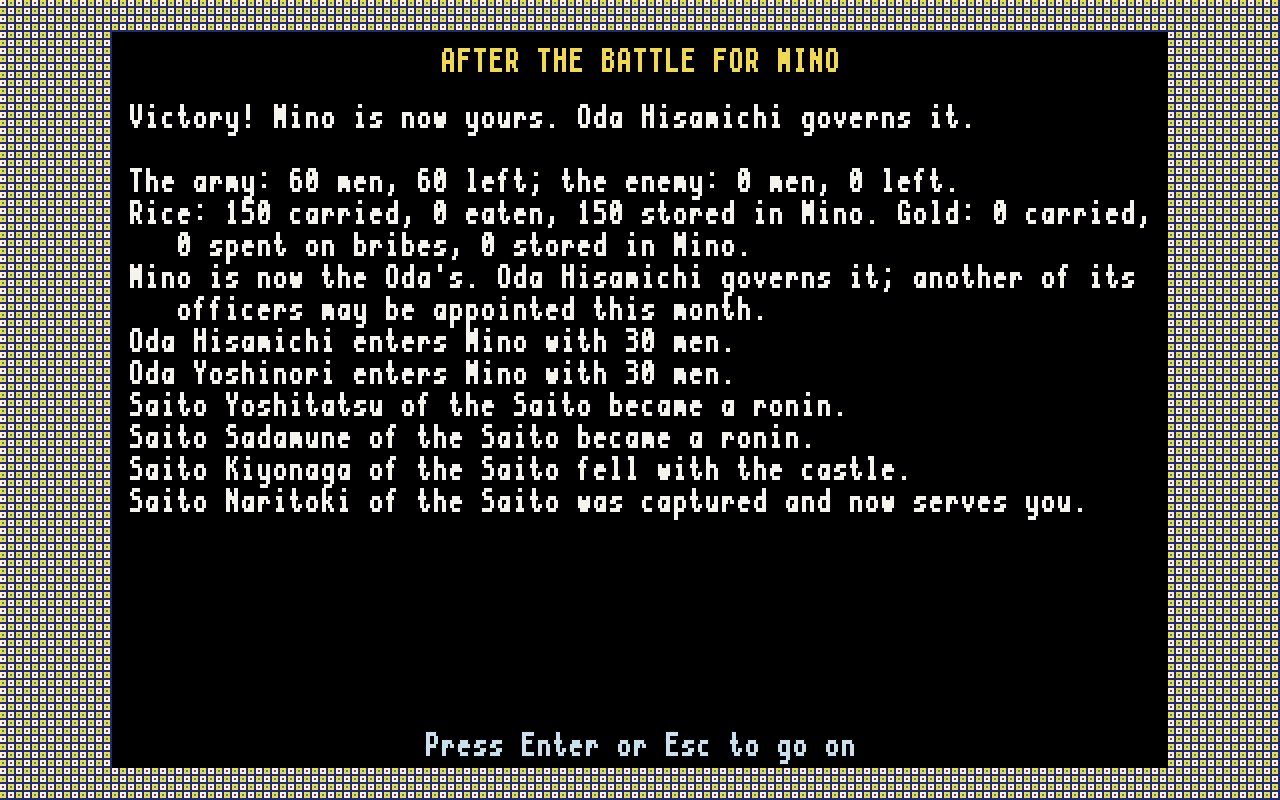
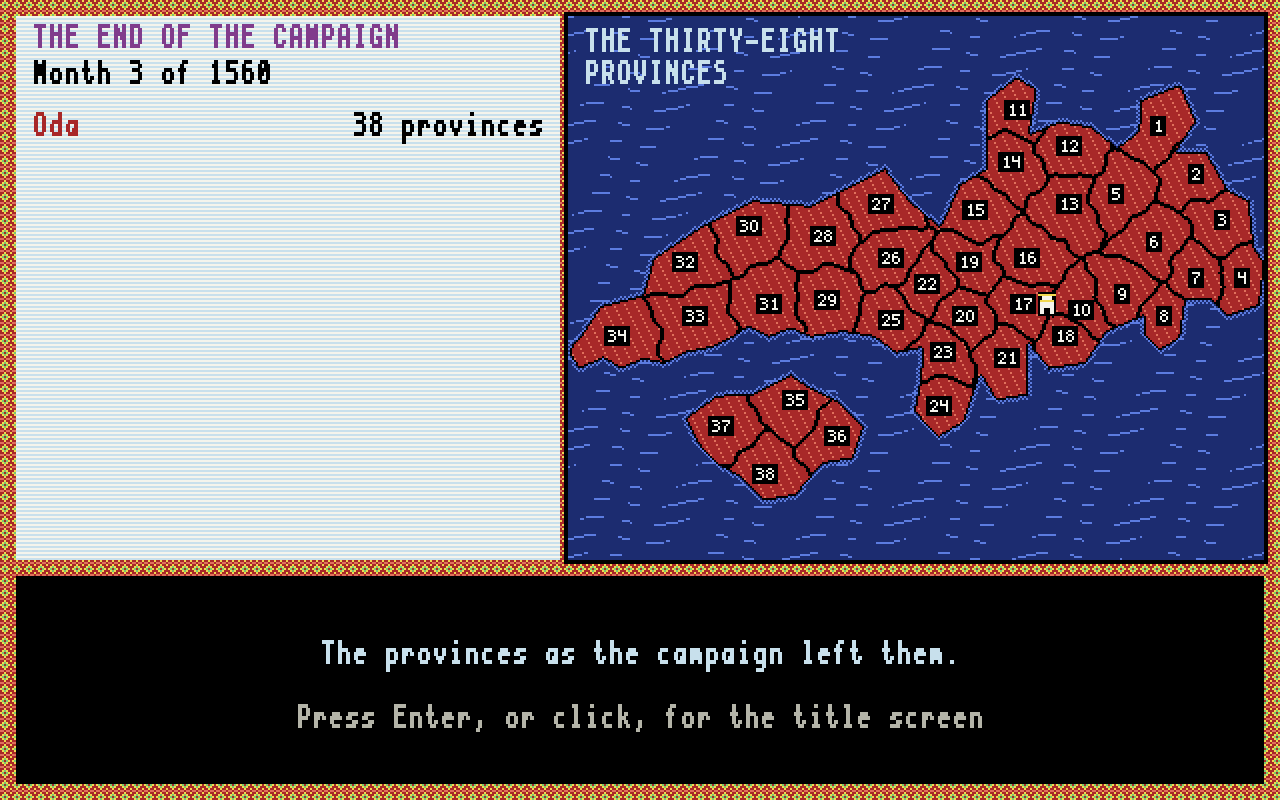
When you make war on a neighbouring province you choose the officers who march, their commander and the rice and gold they carry, and fight the battle yourself on a hex field: every officer leads his own unit among roads, forests, hills, mountains, a river and the defender's castle. Deploy your army, then fight through the morning, afternoon and night of each day with movement points, ordinary attacks, rifle fire, charges and ambushes; halt, flee, bribe an enemy unit or call in a reserve. Destroy the enemy commander to take the province and choose its governor; afterwards you see a summary of the battle and every officer's fate. The chronicle keeps the whole campaign, and the end shows your rulers, your great battles and the map as you left it. When an enemy marches on one of your provinces you choose whether to lead the defence from the castle yourself or leave it to your generals. Hold all thirty-eight to win. Up to nine people can play at one computer, taking turns, or nobody: watch the computer clans fight it out.
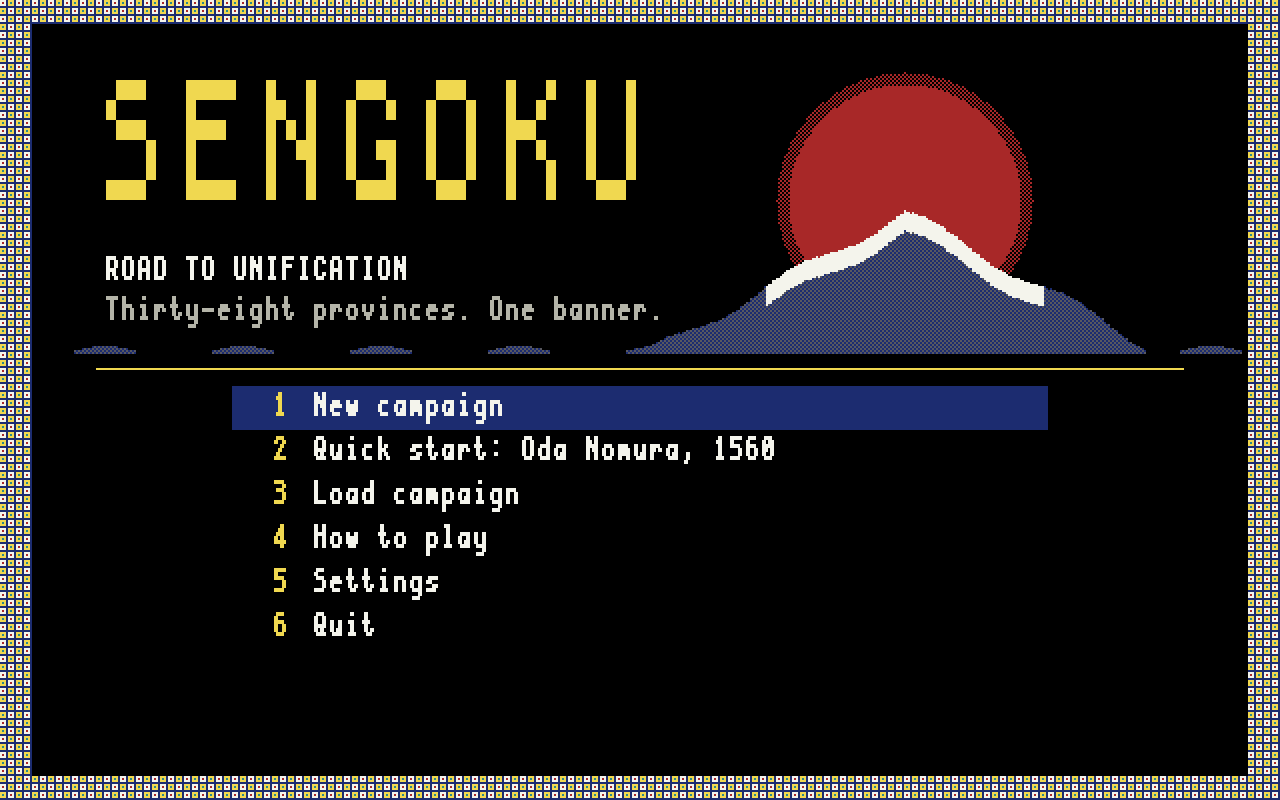
You can also play it in your web browser, with nothing to install. The browser edition is the same game, version 1.7.0, and it saves in your browser. Export and Import move a campaign between the two editions as a save file.
Multi-player games: choose Multi-Player game on the title screen of the browser edition. Make a player name, start a game and give your friends its invite code, or join theirs; up to eight players each lead a clan. Orders take effect at once, and you fight your own invasions on the hex field. The month ends when everyone has ended their turn, or at a time limit the game's creator chose (12 to 72 hours); anyone who has not played by then has their month played by the computer, and keeps their clan. You get emails about your games (you can turn these off). Multi-player games are played in the browser edition only. More in the documentation.
Screenshots
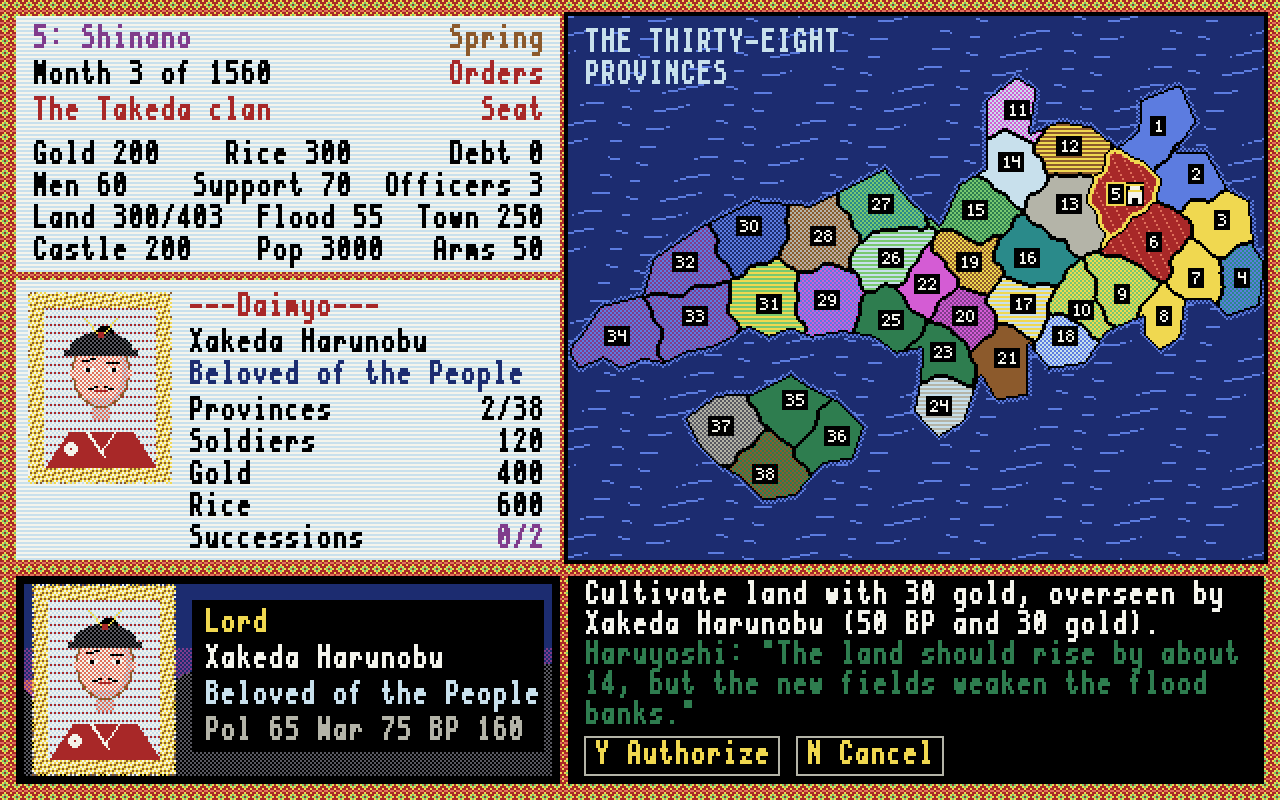
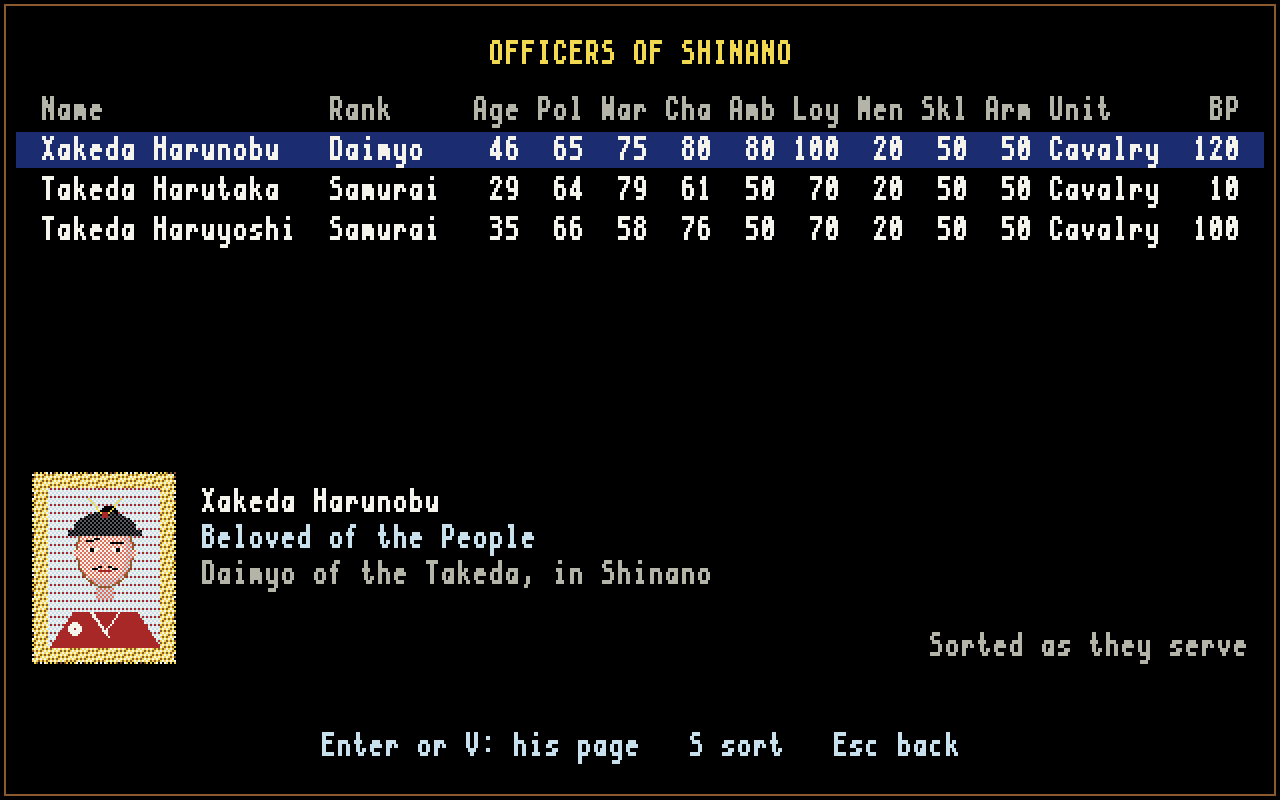
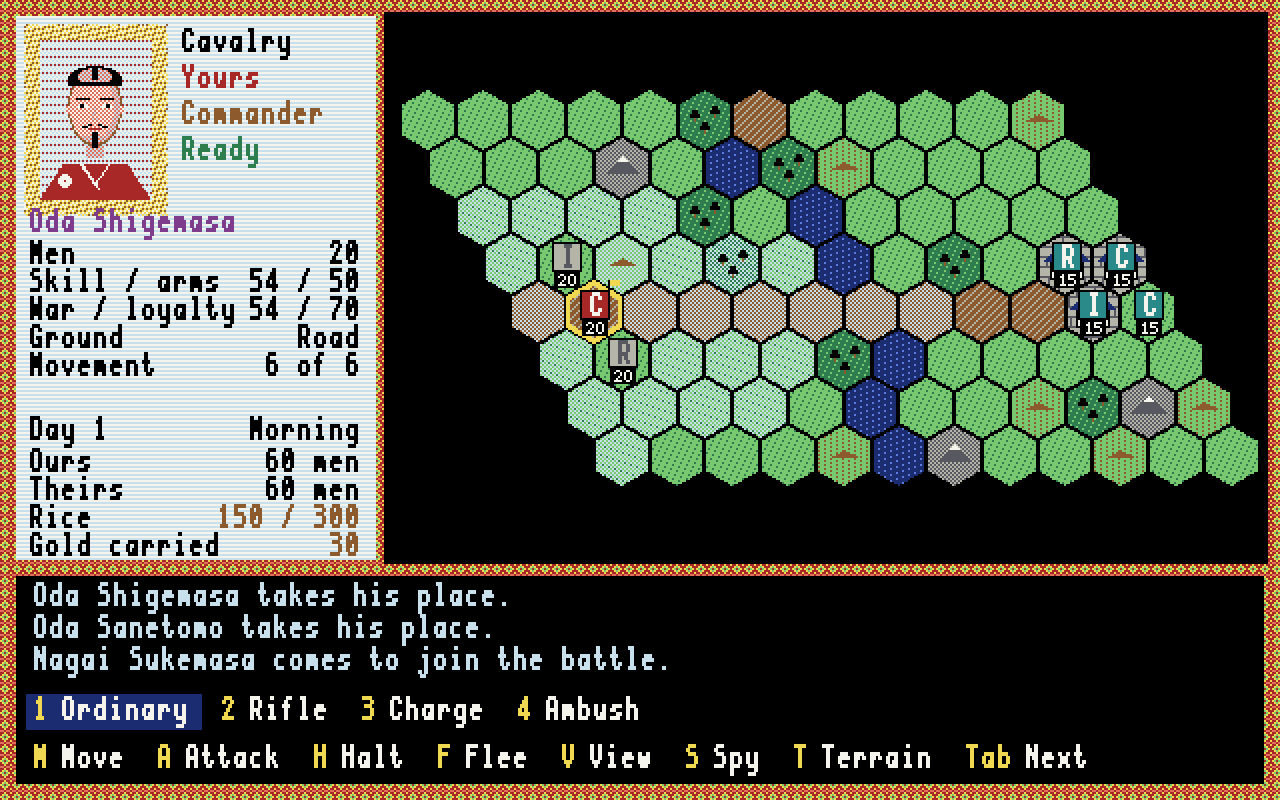
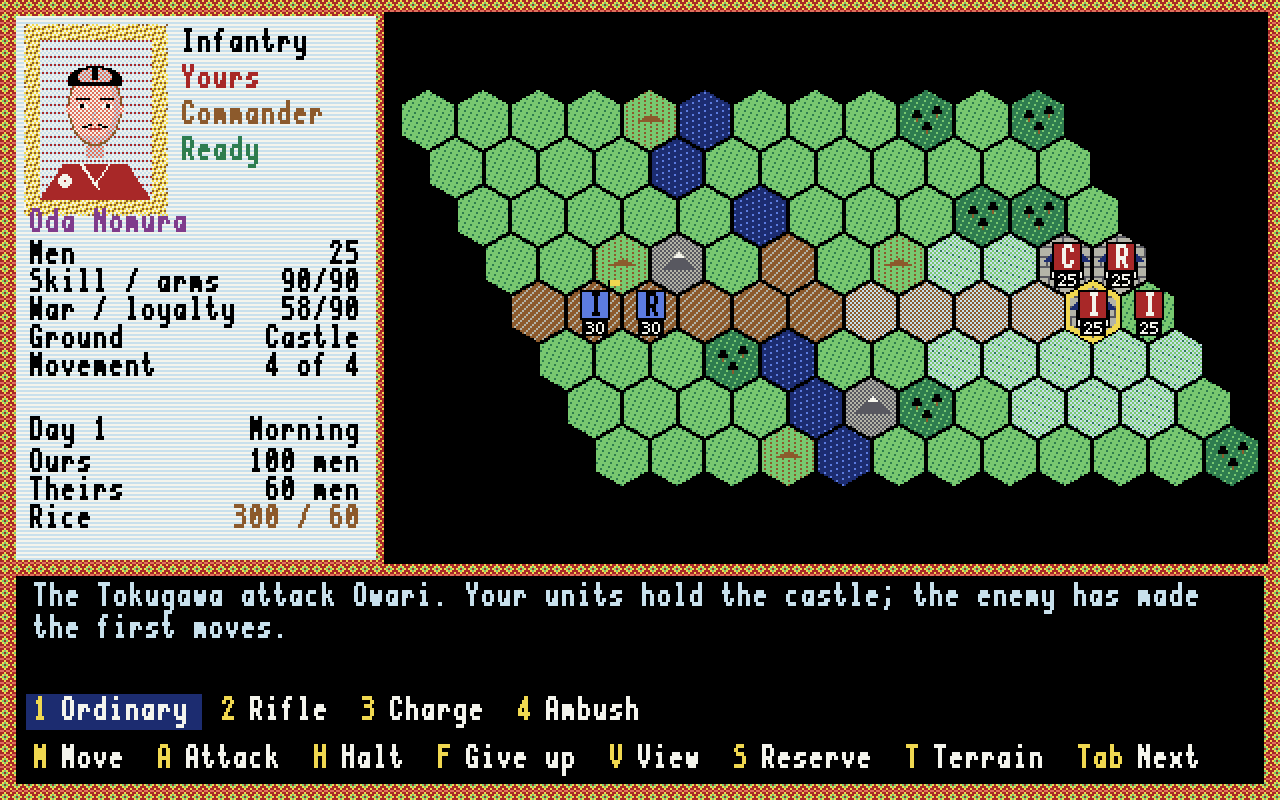
Features
The game
- The 38 provinces of Japan; two scenarios, 1560 and 1582; 28 clans
- Five levels for the computer clans, from Gentle to Ruthless
- Up to eight officers a province, each with politics, war, charisma, ambition, loyalty, body points and his own men; ronin to recruit
- Your lord, his seat, his death and the successions
- Land, flood control, towns, castles, soldiers, training, trade, debts, rice and gold
- Marriages that tie the clans, alliances, threats, tribute and envoys; relations between the clans; delegated governors who may serve well or rebel
- Agents who spread rumours, incite uprisings and assassinate
- A market where rice and arms prices change each month
- Hex battles of officers' units: deployment, day and night, movement points, rifles, charges, ambushes, bribes, reserves, terrain and castles
On your computer
- A 640 × 400, 16-colour screen of its own that scales to any window
- Portraits for every lord and governor, and music made by the game itself
- Keyboard or mouse
- One player, or up to nine taking turns at this computer, or none to watch the computer clans (online games are in the browser edition)
- Five save slots, each with a backup of its previous save, and an autosave at the end of every month
- Export and Import save files, to move a campaign to or from the browser edition
- A chronicle of the whole campaign, kept in its saves
- The rules table in a rules.ini file you can change
- No internet connection, account or server needed
Installing
Windows
- Download
Sengoku-1.7.0-x64.msiand run it. It installs for your user only, so no administrator password is needed, and adds Sengoku to the Start menu and the desktop. - The installer is not code-signed, so Windows SmartScreen may warn you first: choose More info, then Run anyway.
The Windows version is built and tested here under Wine. If something doesn't work on your Windows PC, please let me know.
Linux
- Download
sengoku_1.7.0_amd64.deband install it:sudo apt install ./sengoku_1.7.0_amd64.deb - Start it from the Games menu, or run
sengoku.
Saves are kept in %LOCALAPPDATA%\Sengoku - Road to Unification\saves on Windows and ~/.config/Sengoku - Road to Unification/saves/ on Linux, and are left alone when you uninstall or upgrade. Saves from earlier versions load in this one.
Downloads
Version 1.7.0, 7 November 2026.
Sengoku 1.7.0 for Windows
Installer for 64-bit Windows. Installs for your user only; no administrator rights needed.
SHA-256 ba9c8b660e37d20fb5b382cee28143ed6f93d801e3a82e80e34b8851ff534f2a
Sengoku 1.7.0 for Linux
Package for 64-bit Debian, Ubuntu, Kubuntu, Mint and other Debian-based systems.
SHA-256 d7271c2910fcb04b31c47f5e8065cba7418cd855b27ab42b1c48be4f1310e8ba
Sengoku 1.7.0 source code
Free Pascal 3.2.2 and Lazarus 4.4 source, with the tests and the build scripts for Linux and Windows. GNU GPL version 2 or later.
SHA-256 650bfe75a38bd4b15ad140ead64228919556f1830121fc57de88a7f6195f1f5e
Also on the BBS in the file area Heisenbergs Files. The player guide and the release notes are here to read first, and rules-example.ini shows the rules you can change; there is more in the documentation.
What's new
1.7.0: you defend your own provinces. When a computer clan marches on one of them, you are asked after the month whether to lead the defence on the battle field or leave it to your generals; leading it, your units hold the castle, you may call in reserves, or give up the castle and leave with your men. Menus and boxes now show their whole text, including whether each setting is on or off and the full description of each save. After a conquest led by your lord, he governs the province himself without being asked. In battle the arrow keys only move the cursor, and an amount typed out of range is refused with the range.
1.6.0: envoys' offers are put to you at the start of the month (accept, refuse, imprison the envoy or decide later); marriages tie the clans; you are told when alliances run out, and allies may offer to renew them. Delegated governors' orders go into the chronicle, power wears down an ambitious governor's loyalty, and a disloyal one may rebel. A new ruler finds his officers less loyal. After a battle a summary heads the officers' fates, and after a conquest you choose the governor. The chronicle is kept in the saves; the territory list warns of unrest and hunger; the end of a campaign lists your rulers and great battles and shows the final map. The rules table can be changed in a rules.ini file. Saves are format 7; older saves still open.
1.5.0: a new battle. Every officer of the army leads his own unit on a larger field with roads, forests, hills, mountains, a river and the castle; you deploy first, and each day has a morning, an afternoon and a night. Units have movement points; attacks are ordinary, rifle fire, charge or ambush; you can halt, flee, bribe an enemy unit or call in a reserve, and afterwards see every officer's fate. You choose who marches, who commands and what they carry. Your lord appoints governors anywhere and may delegate provinces to them. New diplomacy: threats, tribute and envoys, with relations between the clans. Trade at a market price that changes. New body point costs for every order, orders for several officers at once, a sortable roster with each officer's page, and a summary at the end. Saves are format 6; older saves still open.
1.4.0: officers. Each province has a governor and up to seven samurai, each with his own abilities, body points, men and unit, and you appoint one for every order from the province's roster; your advisor says what he thinks before you authorize it. New orders move officers with their men, recruit ronin and rivals' samurai, dismiss and train officers, reassign men, spread rumours and assassinate. Each of your provinces gives its orders in turn. Develop orders rise on the screen; floods come with the rains; the moneylenders add a tenth when they lend. Other has Display time, Animation, Sound and Hex battles. Saves are format 5; older saves still open.
1.3.0: the credits and a title picture; up to nine players taking turns at one computer, or none to watch; choose your fief on the map, name your lord and stop his abilities as they count; a new main menu of ten orders; debts; the computer clans fight their wars on the hex field, and you can watch them.
1.2.0: Export and Import. In Campaign > Save, Export to a file saves the campaign to a file you choose; in Load, Import from a file opens one. The file is the same in both editions, so a campaign can move between the browser and the desktop. The desktop edition now saves itself at the end of every month, and Continue on the title screen picks up from there, as in the browser.
1.1.0: the first desktop release. Multi-player games in the browser edition, for up to eight players. Saves are now format 3, which can hold several players' clans; older saves still open.
1.0.0: the browser edition, put up on 3 November 2026.
Licence and source
Sengoku is Copyright © 2026 Michael Slater. It is free software: you may copy, change and share it under the GNU General Public License, version 2 or (at your option) any later version. It comes with no warranty. The desktop source is in sengoku-1.7.0-source.tar.gz above; it builds with Free Pascal 3.2.2 and Lazarus 4.4 on Linux, for Linux and Windows. The browser edition's source is linked from the top of the game page.
Contact
Questions, bug reports and suggestions are welcome. Email slaterm@theiguru.au, or leave a message for the sysop on the Kalgoorlie Retro BBS (telnet bbs.theiguru.au).